Harp Therapy Moments

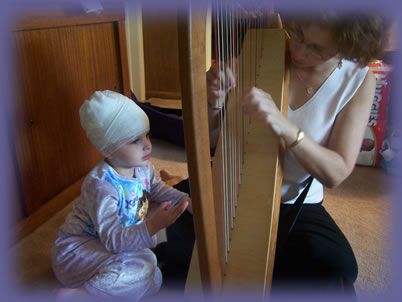
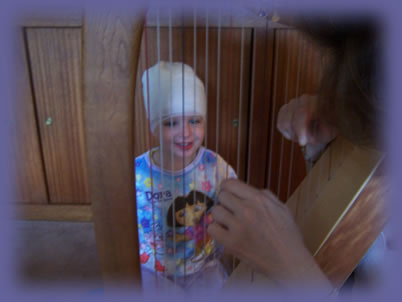
Documentation of harp therapy sessions is an important aspect of this work, and below are a few notes from Cheryl's experience.
The parents of a 17-year-old boy, admitted to the pediatric intensive care unit to die after a long battle with Hodgkin's disease, shared this with the hospital chaplain and primary care nurse: When the harp therapist entered our son's room, he had been fighting the medication, and was extremely agitated all day. Soon after the harp music filled the room, his entire body relaxed and he started to let go. His breathing slowed, and he seemed comfortable at last. We will forever be grateful for the harp music that day because it relaxed him, and us, and we shared his last 6 hours in peace.
An oncology nurse requested that I visit her patient, a 60-year-old woman with cancer, who was anxiously awaiting a surgical procedure that morning. The patient had heard harp music in the hospital hallway the day before and wished for a private visit. Upon entering her room, the patient was restlessly moving around in her bed and looking quite frightened. Her husband was sitting in her room, staring at the floor. On seeing me, the patient said: Thank you so much for coming to see me today. I have been waiting for a visit. She then closed her eyes, rested her head on her pillow, and smiled peacefully. As I played some lullabies for her, tears flowed down her face, her breathing slowed, and her body posture relaxed into the bed. She whispered to me: The music is so beautiful, while her husband looked on and nodded his head appreciatively. Within 15 minutes, she was snoring and sleeping deeply. Her husband smiled at me and said: Bless you.
Many days as I played my harp throughout the hospital corridors, elevators, and patient floors, nurses and doctors and other hospital staff would make remarks to me, such as: That's so beautiful! Could you follow me around all day? It's so stressful working here and that music is so peaceful and relaxing. I could fall asleep right now. Could you please play for my patients? There were various reasons why nurses requested me to play for their patients. It was often because the patient loved music, was a musician, needed pain relief, was depressed and lonely, needed a distraction from the hospital boredom, was dying, or was very scared.
I entered the labor and delivery unit, hoping to play for a woman in active labor. Instead, the nurse requested I play for a woman who had just delivered a baby that died. When I entered her room, her husband and sister were sitting quietly, staring at the floor. The patient, however, greeted me with a big smile from her hospital bed. As I played some lullabies for her, and her lost baby, she closed her eyes, smiled peacefully, and rested. Then she shared this: My mother was a music teacher and played many musical instruments, but her favorite one was the harp. I loved to watch her play her harp at concerts. Your music is so beautiful. Thank you for playing for me! When I later shared this story with the hospital chaplain, he expressed what a blessing it was for this patient that I was there at that moment in time, that divine intervention was surely involved, and suggested that her mother's spirit had come to be with her departed baby.
Upon entering the residential hospice, the nurse requested I play my harp for an elderly woman in their angel suite, a large and beautifully decorated room for an actively dying patient. The nurse mentioned that the patient had been hanging on for days. The patient was quiet and unresponsive, breathing slowly, and her adult son and daughter were resting on the sofas when I arrived. The family awoke and welcomed my offer for harp therapy. Sitting at her bedside, I noodled (improvised) slowly in a pentatonic scale. The patient’s breathing slowed and her body relaxed. She opened her eyes briefly, but made no eye contact. I played a couple of lullabies, and then her children approached her bedside. I ended with “Love Me Tender” as her children, looking on with tears, bent over to kiss her. Within those 15 minutes, she gently let go and died very peacefully. Her children thanked and hugged me, and I left the room to notify the nurse of her passing.
I received an urgent request one afternoon to come to the dialysis unit where a young adult patient with developmental disabilities was creating havoc. I was told that this patient, who receives dialysis 3 times/week, is an ongoing challenge to the nurses and creates terrible stress for the other dialysis patients. When I entered the unit, the patient was talking very loudly and nonsensically, yelling out for no apparent reason, and disturbing everyone there. I approached her slowly and she told me to go away because she hates the harp. I stepped back, but continued to play quietly. She started asking me questions and watched me play. Her talking became softer, and her speech was more coherent. Eventually, she started singing along and smiling. After 30 minutes of playing, she thanked me and agreed it would be ok if I came back again. The nurses were immensely thankful and said: You really quieted her down! Her agitation went from a 15 to a 5. Look, those 2 patients over there have finally fallen asleep. One patient receiving her dialysis treatment exclaimed to me: If I could, I would get down on my hands and knees and kiss you!
The daughter of a 75-year-old Hispanic woman invited me into her mother’s hospice room to play my harp. The patient was Puerto Rican and only spoke Spanish. Nonetheless, she smiled at me as I played Latin American rhythms. The daughter cuddled with her mom in the bed and they joyfully listened to the relaxing and familiar music. The daughter asked me to play “En Mi Viejo San Juan” (In My Old San Juan), a song of great significance to them, but I did not know it. Wanting to satisfy their request, I searched for and found the sheet music, and brought it in to play for them at a later date. Several female relatives from Puerto Rico were visiting, along with her 3 daughters. There was a festive air in the room as I played several Spanish songs. The patient smiled as the family sang, clapped, and offered praise. When I played “En Mi Viejo San Juan”, the patient closed her eyes and relaxed, while the family cried. Later on, the oldest daughter and I spoke privately where she thanked me for playing their special song and shared that it was the first time, since her mom had been diagnosed with terminal cancer several months ago, that she had cried. I have been so busy taking care of everybody and everything that I haven’t had a chance to cry. Hearing you play that song opened me up to let out my feelings.
A 20-year-old woman in a coma was admitted to the surgical-trauma intensive care unit after a motor vehicle accident three weeks earlier. The patient's mother requested that I play at her daughter's bedside, and as I did, she told me all about her daughter. Through tears, she said: Oh, the music is so calming and I know that she can hear it, even if she doesn't seem to respond. I appreciate that you came to play for us, and hope you will come back again.
While strolling with my harp through the hallway of the pediatric hematology/oncology unit, I heard a young child crying. When I reached this darkened room, a young mother was trying to comfort her 18-month-old son. She invited me in as I played "Twinkle, Twinkle, Little Star". The boy looked at me with surprise, and his crying slowed to a whimper. His mother and I began to sing the "Eensy, Weensy Spider" and the "Barney" songs. He reached for the harp strings, smiled, and clapped his hands. After two lullabies, he drifted off to sleep. The mother put him in his crib, sighed deeply and said: Thanks for calming him down! He hasn't slept all day or night and we are so exhausted.
A 70-year-old woman, recovering from a heart attack, cried with joy when I entered her room at the request of her dear friends. She loved church music, so I played "Amazing Grace" and some other hymns. Her body relaxed and she sang along. She told me: You have made my day. I feel so cared for and blessed by your lovely music. I know that I will get better now and heal. Thank you!